
From Surgery to Snuggles: Pregnancy and Motherhood With an Ostomy
Krista, who lives in Canada, feared that becoming a mother might not be possible because of her severe Crohn’s disease and her ostomy. Fortunately, she conceived quickly, and went on to successfully navigate pregnancy, birth, and motherhood.

Read about Krista’s journey from ostomy surgery to motherhood.
For as long as I can remember, I’ve dreamed of becoming a mom. I’ve always loved being around kids, which is what led me to become a teacher.
When my medical team and I were planning my ileostomy surgery due to severe Crohn’s disease, one of their biggest hesitations, since it wasn’t an emergency, was my age. I was only 26 and had always wanted to have children of my own. They told me that ostomy surgery, especially when it involves removing the rectum and anus, can lead to scarring that may reduce the likelihood of conceiving naturally.
With my wedding just months away, my medical team and I decided that moving forward with the surgery was the right choice for me. Because I hoped to get pregnant and had no disease present in my rectum, they recommended a temporary ileostomy rather than a permanent one. This approach, combined with laparoscopic surgery, helped preserve my chances of conceiving while minimizing the risk of scar tissue.
I spent three years living my best life with the newfound freedom that my ostomy gave me. My husband Jason and I explored and hiked across Alberta and British Columbia before we decided we were ready to start trying for a baby.
Our journey to conceiving
My medical team told us that even with my temporary ileostomy, conceiving could be challenging due to the severity of my disease and my history of multiple abdominal surgeries. Jason and I went into it feeling both excited and nervous about the journey ahead. But to our surprise, we became pregnant with a girl in our very first month of trying.
I still remember sharing the news with my gastroenterologist. He smiled and was so happy for us. Jason and I were overjoyed, of course. We couldn’t wait to share our news, our little miracle, with our family and friends. For once, it felt like something had come easily for me. I was so ready, and so excited, to become a mother.
My pregnancy experience with an ileostomy
Thankfully, being pregnant was a positive experience for me. Overall, I felt well throughout all nine months. In the beginning, however, I did experience some severe nausea that led to dehydration, which can happen more easily with an ileostomy. Thankfully, this was managed quickly with medication and I began to feel much better.
It was such a surreal feeling to be growing life. I truly enjoyed being pregnant and documenting each week as my belly grew bigger. The kicks, flutters, and hiccups were so special to experience. My ostomy gave me my life back, and because of that I was able to create life. What a beautiful full-circle moment.
Because of the complexity of my Crohn’s Disease, my medication regimen, and my ostomy, my pregnancy was considered high risk and was followed by several specialized teams. One of these was the Inflammatory Bowel Disease (IBD) pregnancy clinic in Calgary. Another was the prenatal clinic, where I had more frequent visits with my obstetrician and additional scans to ensure the baby was developing as expected. I felt very well cared for and supported by both teams.
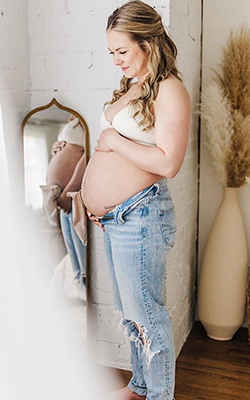
Worries I had when I found out when I was pregnant
Although I was excited when I got pregnant, I did have some concerns because of my health history and my ostomy. Some of the questions I had were:
Will my stoma get really big?
One of my biggest worries was that my stoma would become abnormally large over the course of pregnancy. It actually did increase in size but only slightly. The change was so gradual that I almost didn’t notice it happening. It was much less dramatic than I had imagined it to be.
Will I get more blockages as my belly grows?
Before pregnancy, I had been dealing with narrowing in my small bowel and would experience blockage-type symptoms. As my daughter grew bigger, she settled on the opposite side of my stoma, as if she knew it was there. I didn’t experience the increase in issues that I had feared.
Will I need to change to different ostomy products throughout my pregnancy as I get bigger? Will I get more leaks?
Leaks are every ostomate’s worst nightmare, so naturally this was one of my big concerns. There’s also a lot of comfort around sticking with the products that you know work for you, so the idea of possibly having to switch things up felt a little overwhelming. But as I moved into my second and third trimesters, I began having regular appointments at the stoma clinic. They monitored my stoma and skin closely and adjusted my appliance as needed. The main change for me was switching from a convex flange to a flat one, along with regularly measuring and adjusting the fit around my stoma as my body kept changing. Thankfully, I did not experience any leaks during my pregnancy, which was such a relief!Will I need to have a cesarean delivery because I have an ostomy?
Like many people, I assumed that having an ostomy meant a vaginal delivery wouldn’t be possible and that a cesarean would be my only option. However, in my case, based on my body and the fact that I didn’t have any perianal disease, my care team recommended moving forward with a vaginal delivery. For me, a cesarean would have meant more surgery and the potential for more scar tissue, something I was hoping to avoid. In the end, I did have an emergency cesarean. But despite it not being what I envisioned or planned, my birth experience was still beautiful.
My postpartum journey
My postpartum period was not all rainbows and butterflies. While I was extremely grateful to be a mom and deeply loved my daughter Lyla, it was challenging for me emotionally and physically. Not long after the birth, my Crohn’s Disease, which had been dormant during my pregnancy, began to flare again. Navigating this while also caring for a newborn was overwhelming at times.
Lyla and I spent many of our early days together outside. We walked every day, sometimes even three times a day, which helped her sleep. During those walks, I would listen to music or a podcast, and enjoy a hot coffee – something any mom knows is a rare luxury.
When we were at home, Lyla preferred to be with me. Since I didn’t have any daytime help, I did a lot of babywearing to keep her comforted while still having my hands free. I was able to do this even with my ostomy.
My ostomy made so many moments of motherhood manageable. I remember thinking, in those early days after Jason went back to work, how much harder things would have been without it. I would have spent so much of my day in the bathroom. And even simple things like getting out for a walk or caring for Lyla, who always wanted to be held, would have felt so much more stressful.
One thing I felt especially passionate about, and had really hoped to experience, was breastfeeding my daughter. Even though it came easy for us, it still brought its own challenges, especially with my own health not being at its best. I’m proud and happy to say that I was able to exclusively breastfeed her for 15 months.
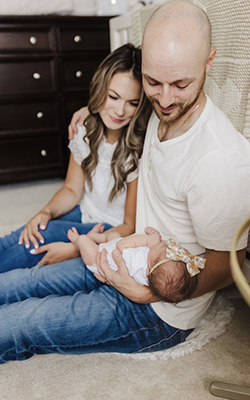
Teaching my daughter about my ostomy
Lyla and I share a very close bond. She’s a true mama’s girl and is incredibly in tune with me. She can always tell when I’m not feeling well or when something is off. She loves to cuddle and always wants to be close.
I’ve always done my stoma bag changes with her right by my side, even when she was a newborn. My stoma has always been, and will always be, a part of me. She will never know her Mommy without an ostomy. As she’s grown, she’s become my little helper. She knows the supplies I use, what they’re used for, and even helps place the barrier ring and flange during a bag change. She’s naturally curious, always asking questions and eager to understand. She even asks to touch my stoma – which I’ve named “Stella” – and says it feels “squishy and slimy.”
She knows that “Mommy’s Stella” helps me play, laugh, cuddle, and live life fully. In our home, we talk openly about bodies that work differently and that differences aren’t something to fear – they’re what make us unique and special.
Now that Lyla’s old enough to ask about my ostomy, I choose to respond with honesty, gentle words, and love. I never want her to see it as something to hide or feel ashamed of. I believe that when we answer children’s questions truthfully, we teach them empathy, confidence, and compassion. I hope to raise my daughter to be part of a generation that is more understanding, inclusive, and kind.
What motherhood looks like for me now
I worry, of course, about what it means for my daughter to have a mom with a chronic illness. Since she was born, Lyla’s seen me navigate frequent flares. But in the midst of that, I also see the beautiful lessons she’s learning along the way – like how to listen to your body, how rest is part of healing, and how to show deep compassion and empathy for others and yourself.
She often asks me, “How is Stella today, Mommy?” She knows everything about my ostomy. She can tell when I don’t feel well and, without hesitation, she’ll set me up on the couch with pillows, my blanket, and my heating pad. “My poor mommy, she is sick. I will take care of her.” she says. She has the biggest, most beautiful heart.
Growing alongside my daughter has been such a beautiful journey. As we continue down this path together, I watch her become the person she’s meant to be. She makes me so proud, and every hardship I’ve faced has been worth it because of her. We don’t have everything figured out but we have so much love. At the end of the day, that’s what matters most.
Three key things I’ve learned along the way
I have three takeaways from my experience with pregnancy, birth, and motherhood with an ostomy that I always share with others:
- Visit your local stoma clinic or ostomy nurse regularly throughout your pregnancy. As your body and stoma change, they can help adjust your ostomy products to ensure the best fit and prevent issues.
- Include your ostomy in your birth plan. Be sure to note that you would like a stoma nurse to come and assess and change your appliance after delivery. This was incredibly helpful for me, especially since I had a cesarean. While I was in recovery, my stoma nurse was able to take care of everything and provide me with fresh ostomy products. He also sent me home with extra products to use as my body continued to change postpartum.
- Enjoy the journey. Embrace the messy, chaotic, and beautiful moments that come with motherhood. Your ostomy doesn’t have to hold you back, but instead can empower you to be the best mom you can be.
My ostomy has given me the freedom to leave the house and be fully present with my daughter, without constantly worrying about finding a bathroom. It’s allowed me to show up for her in a way I’m deeply grateful for, because these moments, these days, are ones I’ll never get back.
Pregnancy with an ostomy may come with some unknowns. However, with preparation and the right support in place, it can still be a beautiful, empowering journey into motherhood.
Krista received compensation from Hollister Incorporated for her contribution to this article. The testimonials, statements, and opinions presented are applicable to the people depicted. These testimonials are representative of their experience, but the exact results and experience will be unique and individual to each person.


